
- A strange purpose often requires a strange building.
Every structure serves a purpose, even if that purpose is just to look pretty. With some buildings, however, you might find yourself at a loss when trying to divine why they’re there.
Certain structures are built for such hyperspecific reasons that they end up looking completely alien. In other cases, you can tell what the building is, but looking at its surroundings, you’d never expect to run into it.
Here are eight examples of very strange buildings that were constructed to complete a single, highly specific task.
1. Flak Towers
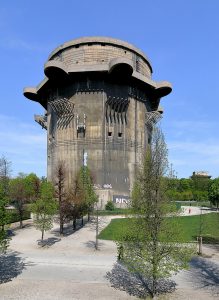
Should you visit Berlin and Vienna, you can’t help noticing some huge and ominous buildings scattered around the cities and their surroundings. Massive, uncomfortably utilitarian concrete towers rise to the sky, like watchtowers of an oppressive regime.
And that’s exactly what they are. You’ve come across the Third Reich’s infamous flak towers.
The Nazi regime built these giant blockhouses to host sprawling arsenals of anti-aircraft cannons during World War II. After the war, the weapons were hauled away, but many of the buildings still tower over German and Austrian cities.
2. Nutty Narrows Bridge
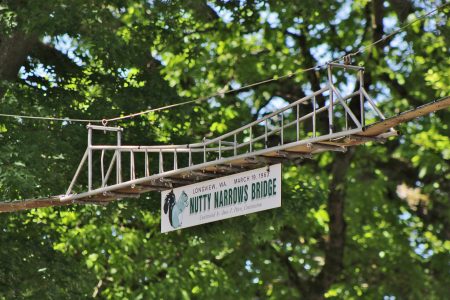
Longview, Washington, is home to an unusual bridge. A tiny suspension bridge dubbed the Nutty Narrows Bridge spans Olympia Way, one of the city’s major thoroughfares.
Although it’s much too small for human pedestrians, a steady flow of bushy-tailed traffic still crosses the bridge. That’s right – the Nutty Narrows Bridge is for squirrels.
Longview put the bridge in place in 1963 after its residents got fed up with all the run-over squirrels on the busy road. Since its inception, the Nutty Narrows Bridge has been renovated twice due to wear and tear.
3. Dutch Cube Houses
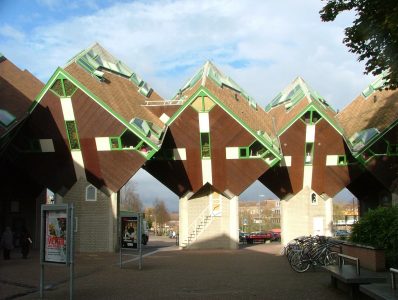
The Dutch cities of Helmond and Rotterdam both host a very futuristic-looking neighborhood. Instead of regular houses, these areas are full of slanted cubes sitting on top of concrete and glass pillars.
These bizarre houses aren’t just an exercise in post-modern architecture. Their strange shapes are intended to maximize urban housing density.
The cubical housing units overlap with each other, allowing apartments to be crammed closer together than with regular apartment blocks. At the same time, they free up the space between their support pillars for public use.
4. Falkirk Wheel
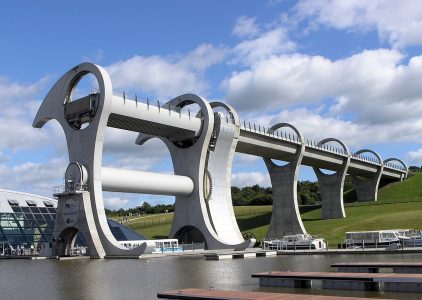
At a quick glance, you might think the Falkirk Wheel is some kind of amusement park ride. And it kind of works that way, but it lifts boats and ships instead of people.
This water elevator connects two canals at different heights. After a boat enters the wheel’s basket, the structure hoists it up 80 feet to the higher canal.
The Falkirk Wheel opened in 2002, replacing an older system that required boats to travel two 11 locks to transfer between the canals. With the wheel, navigating from one canal to another is much faster.
5. Acoustic Mirrors
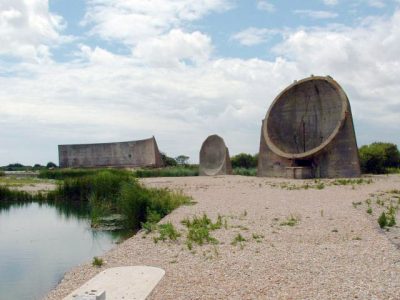
Scattered around England’s southern coast are mind-boggling concrete structures with concave dents in them. They aren’t modern art installations but acoustic mirrors that used to be part of the U.K.’s national defense system.
Before radar became a thing in the closing years of World War II, detecting approaching aircraft required people to constantly peer at the sky to spot enemy planes. These acoustic mirrors, however, allowed military personnel to hear oncoming planes from much farther than they could see them.
The parabolic mirrors catch sound waves from airplane engines and reflect them toward their center, amplifying the sound significantly. They would’ve worked, but the mirror network was never actually used since effective radar became available just as their construction finished.
6. Bremen Drop Tower
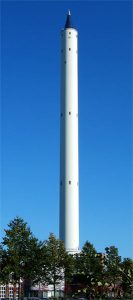
In the German city of Bremen stands a 490-foot-tall, thin tower. It exists for a single reason – to allow scientists to drop objects from really high.
The Bremen Drop Tower serves the Center of Applied Space Technology and Microgravity at the University of Bremen. At the center of a concrete shell is a drop tube that allows scientists to drop things without weather or other factors affecting their fall rate.
Frogs, fish, and solid objects have all experienced up to 9 seconds of weightlessness in the tube, enabling researchers to record the effects of zero gravity. In addition, the tube can be used as an isolated chamber to produce temperatures just a smidgen above absolute zero.
7. Super-Kamiokande
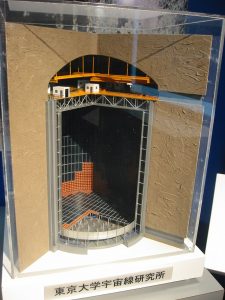
Super-Kamiokande is located 3,300 feet underground in the Mozumi Mine in Japan. This strange structure consists of an enormous, 129 feet wide and 136 feet tall stainless steel tank.
This tank is full of ultrapure water and lined with hundreds of light detectors. Its purpose is to allow physicists to detect and observe rare, ghostly particles called neutrinos coming from space.
Which, for some reason, appear in this huge water tank underground. Look, I’m not a physicist; don’t ask me how this works.
8. Fuyao Ladder Elevator
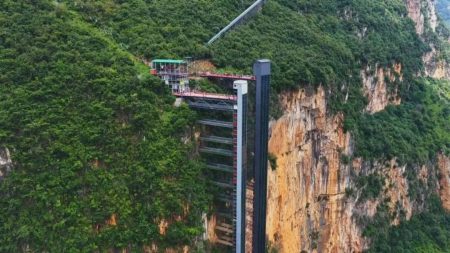
The Fuyao Ladder is a 945-foot-tall panoramic glass elevator running up a mountainside in the remote countryside of China’s Yunnan province. This modern structure stands in the middle of nowhere for a noble cause – it allows children to get to school.
At the bottom of the near-vertical cliff is a village, and the nearest school is on top of the cliff with no road going to it. Before the Fuyao Ladder opened in 2022, the village’s children had to brave a perilous climb up the rock face on rickety ladders and ropes.
After the elevator opened, the kids could get to their lessons without risking their lives. Then, something unexpected happened. The scenic elevator became so popular with tourists that the children would sometimes have to wait hours in line.
So, what did the Chinese government do? They built another, bigger elevator just for tourists that opened in 2026. Now, kids can again get to school in time on the original elevator.
Interested in more unusual architecture? Check out the 8 coolest (and strangest) churches around the world!