
- Oceans are weird places, in case you weren’t aware.
There are plenty of haunted houses and dark forests on land to give you the creeps. But things aren’t much better if you set out on the open sea.
Multiple regions of the world’s oceans a notorious for being weird and unsettling. It might be because of the rumored supernatural phenomena, the things lurking beneath the ocean surface, or simply because they’re plain dangerous.
Here are seven strange and creepy oceanic regions that make even the saltiest of seadogs want to change course.
1. Bermuda Triangle
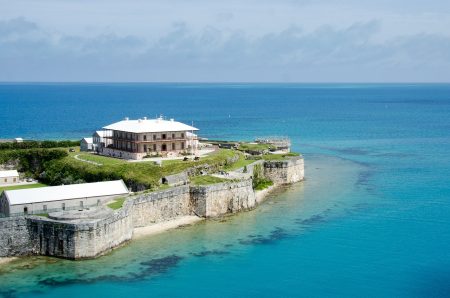
The most famous of all creepy ocean zones must be the Bermuda Triangle. It consists of the area between the island of Bermuda, the southern tip of Florida, and Puerto Rico.
This region is notorious for multiple disappearances that have happened in its waters. Ships and airplanes alike have sunk into the ocean or even vanished into thin air.
You might think the Bermuda Triangle has a centuries-long history of swallowing ships, but it actually didn’t pop into the public consciousness until the 1950s. At the time, newspapers suddenly became interested in incidents that have happened in the region, among them the disappearance of five U.S. Navy torpedo bombers in 1945.
People have put forth various explanations for the disappearances, ranging from strange magnetic activity that confuses compasses to aliens. That said, statistically Bermuda Triangle isn’t any more dangerous than any other area of the sea, despite its volatile weather.
2. Devil’s Sea
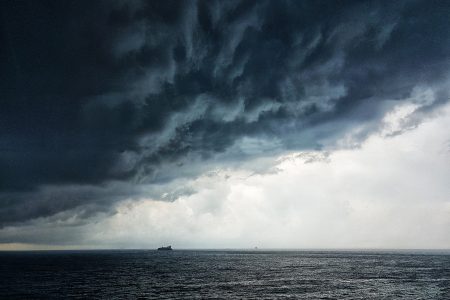
As if one creepy ocean triangle wasn’t enough, there’s another one roughly on the other side of the world. The Devil’s Sea, also known as the Dragon’s Triangle, is a region of the Pacific falling somewhere between Tokyo, the 145° meridian, and Guam.
The Devil’s Sea first gained notoriety at the end of WWII, when a Japanese Zero fighter plane disappeared in the area. The pilot’s last message was quite unsettling: “Something’s happening in the sky … the sky is opening up…”
Since then, nine ships have reportedly vanished or sunk in the Devil’s Sea in seemingly perfect sailing conditions. Some have speculated that undersea volcanic activity in the Devil’s Sea could result in rising gas bubbles that suck ships underwater when they burst at the surface.
That wouldn’t explain what the Zero pilot saw in the sky, though.
3. Sargasso Sea
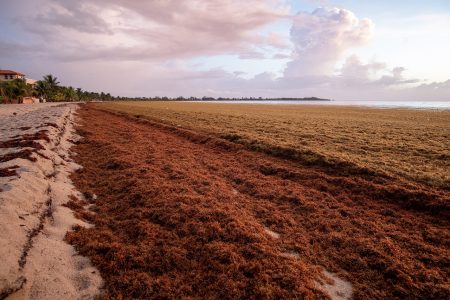
The Sargasso Sea is a large stretch of ocean sitting just east of the Bermuda Triangle. Unlike all other bodies of water dubbed a “sea,” the Sargasso Sea isn’t bordered by land.
Instead, strong ocean currents form its borders. The currents leave an eerily calm area between them, which is ideal for the Sargassum seaweed to flourish.
And boy does it. The masses of seaweed are so thick that they can trap — and have trapped — ships in their midst.
It’s no wonder then that the Sargasso Sea is supposedly full of ghost ships. It’s sadly also full of plastic, since the surrounding ocean currents deposit almost anything thrown into the surrounding waters in the middle of Sargasso, where the stuff gets tangled in the seaweed.
4. Neptune Memorial Reef
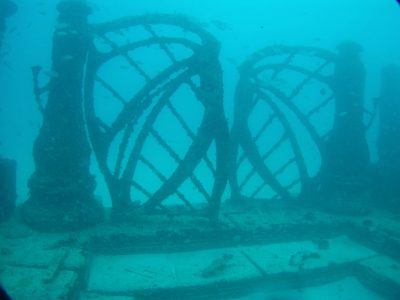
The Neptune Memorial Reef lies on the bottom of the Atlantic, some three miles off the coast of Florida. It’s one of the largest man-made reefs in the world, and also the world’s largest underwater cemetery.
The reef has enough space to accommodate 850 departed people. During the burial process, the body is cremated and the ashes are mixed into cement that a diver deposits in the reef structure.
One of the most famous individuals buried in the Neptune Memorial Reef is the TV chef Julia Child.
Divers are free to visit the reef, as long as they don’t mess with it. Fishing, however, is prohibited in the area, for some reason.
5. Great Blue Hole
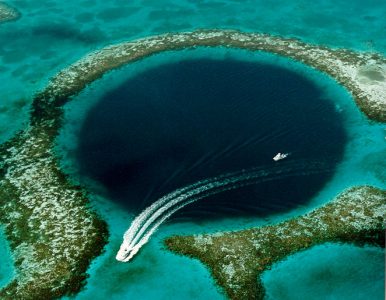
How could there be a hole in the ocean? Well, go see the Great Blue Hole in Belize and you’ll see.
The Great Blue Hole is a massive, circular sinkhole on a small atoll in the Lighthouse Reef. In an otherwise shallow sea, the hole suddenly plunges down to a depth of 407 feet.
At the bottom of the hole sits a creepy layer of hydrogen sulfide, which renders the water devoid of oxygen and unable to support any life. A submarine discovered the lifeless zone in 2018 — alongside the bodies of two divers who had gone missing while exploring the hole.
Despite that, the Great Blue Hole is among the world’s most popular diving locations. And it is admittedly very beautiful, as long as you ignore the deadly depths.
6. Corryvreckan Maelstrom
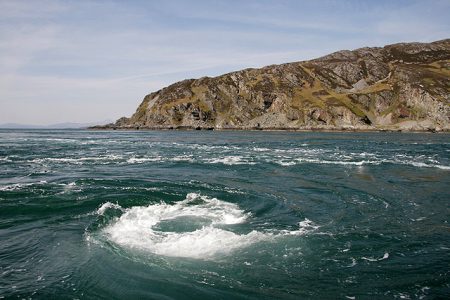
While the Great Blue Hole is more of a figurative hole in the sea, the Corryvreckan Maelstrom is quite literal. It’s a permanent whirlpool — the world’s third largest — that constantly rages off the western coast of Scotland.
Located in the Gulf of Corryvreckan, the unusual shape of the sea floor together with the tide creates incredibly strong currents in the area. The maelstrom churns with such fury that you can hear it more than 10 miles away on a calm day.
Needless to say, the thing is a little bit dangerous. It’s likely the most lethal area of the sea around Scotland and boaters and divers alike are encouraged to steer as clear as possible of the maelstrom.
7. Cuban Underwater City
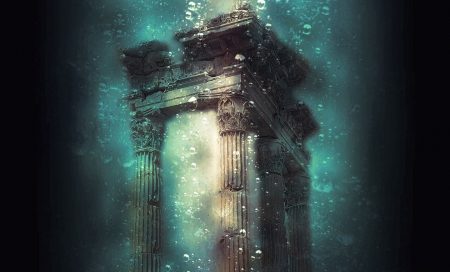
A mere three miles off the western tip of Cuba, at a depth of 2,400 feet on the bottom of the Caribbean, there’s something. Nobody knows what, though.
In 2001, the sonar of an oceanic exploration mission recorded a 200-hectare area that appears to be covered in huge geometric stone structures. All features of the sonar scan indicate that this is some kind of a city.
But the kicker is that, according to estimates, the city would have to be 50,000 years old for it to have sunk to the depth where it is now. To put that in context, that means the city would’ve been built in the middle of the Stone Age when the most sophisticated known settlement was a bunch of reed huts with a storage pit in the middle.
Is the thing on the bottom of the sea really a city? And if it is, who built it?