
- Playing chess and using silk umbrellas? Not back in my day!
Social media, video games, inappropriate music… Everyone knows these are all things that are turning our kids into brainless, lazy slobs!
It’s sometimes tempting to blame anything and everything for making worthless good-for-nothings out of today’s kids. The thing is, though, older folks of the past have said the same thing about, quite literally, anything and everything.
Complaining about those darn kids is a tradition probably as old as the human race. Already Grug the Cave Grampa was likely grumbling about how the young’uns were making fire and banging rocks on things.
However, with technological and cultural changes, some of those complaints seem pretty silly today. Here are seven examples of odd things older people have blamed for ruining the youth.
1. Cities

There is and will always be something inherently wholesome about country life. In 1904, however, psychologist Granville Stanley Hall cited the lack of rural living as contributing to young folks’ moral decay in his Psychology of Adolescence.
According to Hall, increasing urban life brought with it “temptations, prematurities, sedentary occupations, and passive stimuli” when what adolescents needed most was an active life. As a result, he claimed kids suffered from “a lessening sense for both duty and discipline.”
Although there’s always a case to be made for an active, healthy lifestyle, it does kind of sound like Hall was upset he couldn’t get his kids to work on his farm.
2. Novels

Movies, TV, and video games are all regular scapegoats for spoiling our kids. But before them, old people would complain about whatever the newest form of entertainment was — like novels and plays.
In 1790, Reverend Enos Hitchcock bemoaned the “free access which many young people have to romances, novels, and plays.” These frivolities had “poisoned the mind and corrupted the morals of many a promising youth.”
Currently, the thing to blame for ruining kids’ minds seems to be TikTok, YouTube Shorts, and other short video platforms. Just know that by doing so, you’re carrying on Reverend Hitchcock’s proud legacy.
3. Chess

These days, chess is typically considered a smart person’s game that requires intellect and logic. In 1859, however, the Scientific American magazine saw things quite different.
An article in the magazine warned that the “pernicious excitement” of playing chess was quickly spreading across the U.S. In the publication’s view, chess was one “cheerless game.”
“Chess is a mere amusement of a very inferior character, which robs the mind of valuable time that might be devoted to nobler acquirements,” the article declared.
Oh, how times have changed.
4. Writing

Written works, like novels or TV shows, could conceivably contain harmful messages. But way back in the day, even the act of writing itself was considered harmful.
There’s supposedly an ancient Babylonian tablet, that contains possibly the oldest known complaints about those no-good kids. One of the many issues the writer lists is that “every man wants to write a book.”
That said, it’s not clear if such a tablet exists, and this quote has also been attributed to Roman statesman Cicero, the philosopher Socrates, and others. In any case, it seems that as long as people have been literate, older people have disliked the youths’ writing.
5. The Waltz
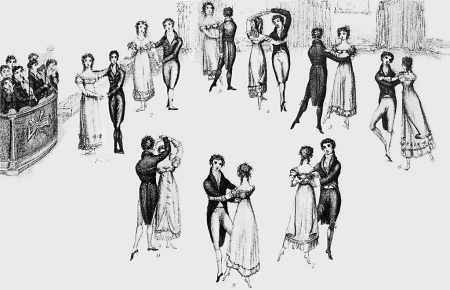
In 1816, a horrible trend was ravaging the young people of England. That fad was the “indecent foreign dance called the ‘Waltz,’” wrote the Times of London.
According to the newspaper, the waltz was such an indecent dance that the dancing couples might as well have been having public sex. “It is quite sufficient to cast one’s eyes on the voluptuous intertwining of the limbs, and close compressure of the bodies … to see that it is far indeed removed from the modest reserve,” the article laments.
You know, back in our youth, our parents used to complain because we didn’t know how to dance the waltz. Yes, we are that old.
6. Speaking Too Briefly

Kids these days don’t even know how to speak properly with their stupid slang, right? Well, that’s a sentiment that’s been around since at least 1332.
That’s the year when Japanese monk Yoshida Kenkou wrote his famous Essays in Idleness. In the collection, he whines about how young people in 14th-century Japan are speaking much too briefly.
“People used to say ‘raise the carriage shafts’ or ‘trim the lamp wick,’ but people today say ‘raise it’ or ‘trim it.’ When they should say, ‘Let the men of the palace staff stand forth!’ they say, ‘Torches! Let’s have some light!’” Kenkou wrote.
In addition, he complained about (then) modern fashions and manners. We’re starting to think that the monk just didn’t like kids in general.
7. Umbrella Materials

Robert Louis Stevenson is one of the world’s most famous authors, having written Treasure Island and Dr. Jekyll and Mr. Hyde. He also believed that fancy umbrellas were a sign that the youths of his day were a lost cause.
In an 1894 essay “The Philosophy of Umbrellas,” Stevenson declared that silk umbrellas were an obvious sign of their bearer’s hypocrisy. “May it not be said of the bearers of these inappropriate umbrellas that they go about the streets ‘with a lie in their right hand?’” wrote Stevenson?
But what did the famed writer consider an acceptable umbrella material? Well, according to him, good, religious youths should use umbrellas made of “decent and reputable gingham.”
This just goes to show that if the kids do anything at all, there’s some crotchety old coot who will whine about it.