
- It’s all fun and games until an intergalactic conflict wipes out hundreds of thousands of dollars of real value.
Multiplayer games can be a lot of fun, allowing you to work with or against other players to overcome challenges too big for one person. But they can also demonstrate surprising things about human cooperation.
Sometimes, those things aren’t pretty.
Player behavior in multiplayer games has (often unintentionally) helped advance our understanding of economics, psychology, and more. Here are six strange occasions where online gaming revealed something about the human soul.
1. The Corrupted Blood Plague
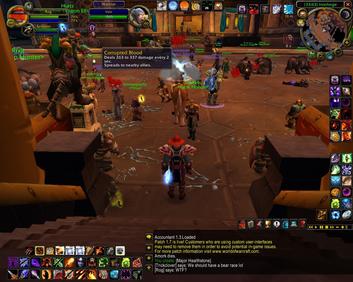
In 2005, the online RPG World of Warcraft released a new boss battle to challenge players. The monster in this particular battle used a spell called Corrupted Blood, a virtual disease that would slowly weaken and kill infected characters unless cured.
The players were supposed to be cured of the disease upon beating the boss. However, a programming oversight allowed the pets and familiars of the Hunter and Warlock classes to remain infected – and infect others.
Once Corrupted Blood breached containment, it rapidly spread throughout the game world, carried by wandering non-player characters who were invulnerable to its effects. Surprisingly, players’ reactions to the digital disease mirrored reactions to real-life diseases.
Some players sought to quarantine themselves to stop the spread, while others with healing abilities tried to help the infected. And then there were those who intentionally walked into populated areas to spread the malady.
Eventually, the servers were shut down, and Corrupted Blood was purged from the world. But the incident showed that online games could be used to scientifically model responses to disease outbreaks.
2. The Falador Massacre
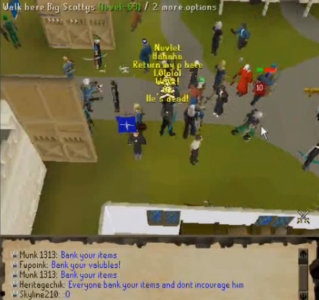
RuneScape, another famous multiplayer RPG, typically restricts player versus player (PVP) combat to specific areas, like gladiator arenas and lawless wastelands. On June 6, 2006, however, these safeguards broke down.
At an in-game party to celebrate the first player to reach the maximum level in the Construction ability, a software glitch unlocked PVP combat for some attending players. Suddenly free to attack anyone, seemingly without repercussions, the party quickly turned into a massacre.
Certain players began to engage in wanton slaughter, killing other characters left and right. As they moved to other areas, they spread the bug, allowing more people to join the violence.
Yet, there were also the heroes who used their newfound powers for good. They took up arms to stop the murderers, often at the cost of their own (characters’) lives.
As with the Corrupted Blood Plague, the Falador Massacre has been studied as a model of what might happen in reality if social order suddenly broke down. Based on historical precedents, it’s a disturbingly realistic event.
3. Albion Online Market Crisis
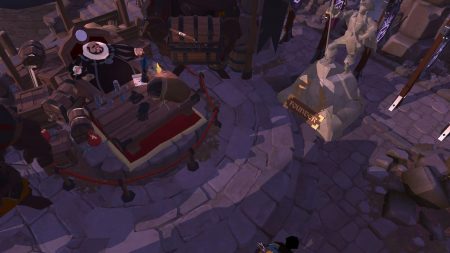
In Albion Online’s multiplayer fantasy world, the players run the economy. The game system doesn’t control the flow of in-game currency, allowing the players to trade, set up companies, and hire other players to work for them as they see fit.
Unlike in real life, though, there are no governmental organizations maintaining fair trade rules on Albion. As such, the game’s economy quickly turned into a battlefield between competing player-run cartels.
The rich company owners immediately bought up all available resources, massively inflating prices and making it all but impossible to do anything without becoming a cartel drudge. They also engaged in rampant corporate warfare, ambushing each other’s trade routes and raiding their stores for goods.
In the end, the developers had to step in and implement in-game taxation systems to prevent a few ruthless corporate lords from running the world. Albion’s market crisis has since become a study model for emerging, unregulated virtual economies.
4. The Bloodbath of B-R5RB
Much like in Albion Online, in the sci-fi space exploration game EVE Online, the game’s incredibly complex economy is entirely player-run. The game (by design) has devolved into a cyberpunk dystopia where all-powerful player corporations rule the galaxy.
In 2014, this situation led to the costliest online gaming conflict in history. And we’re talking in terms of real money.
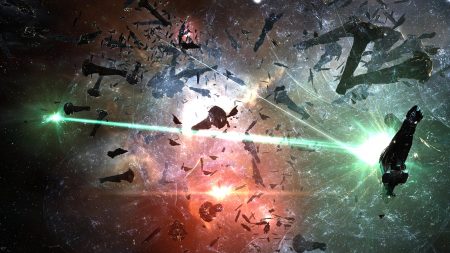
The Bloodbath of B-R5RB began as a relatively innocent attempt to collect unpaid bills. To cut a long story very short, the debtor got upset and called in some guys, which upset the creditor, who called in some guys. Some weeks later, the row culminated in a staggeringly epic space battle in the galactic region B-R5RB.
After more than 12 hours of warfare (the longest PVP battle in gaming history), thousands of spaceships were destroyed. The total damage in in-game currency numbered an estimated 11 trillion galactic credits.
The thing is, since the EVE Online economy is so accurately modeled and closely tied to genuine markets, the developers were able to put a real price tag on the war. The feuding player cartels wiped out more than $300,000 worth of assets.
5. The MissingNo Glitch
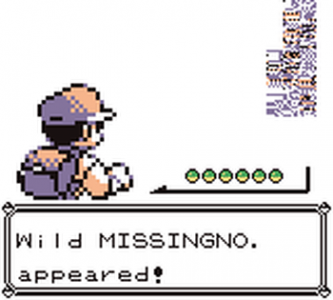
Here’s something you may be aware of. In the original Pokémon Red and Blue games, there was an extremely rare Pokémon that wasn’t supposed to exist: MissingNo.
This glitched-out Pokémon could be found and caught after performing a very specific set of game-breaking actions. Once caught, there was a high chance MissingNo would corrupt the save file and destroy your game data.
But here’s the thing: if your data stayed intact, its glitchy behavior allowed players to duplicate items. That included powerful and rare items that would increase your Pokémons’ power and level and teach them strong abilities.
Although Pokémon is a single-player game, it has a PVP battle component that allows players to pit their Pokémon against each other. Some players’ ability to overpower their Pokémon completely upset the balance in global tournaments.
And how did players learn about the MissingNo glitch? Using this little thing called the internet. MissingNo is famous for being one of the gaming phenomena whose infamy was primarily spread through online means.
6. The Mad Bartender
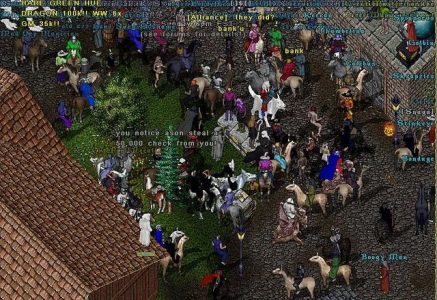
Our last story takes us to the world of Britannia in the multiplayer RPG Ultima Online (one of the first modern games of its kind). In particular, these events happened on a hardcore roleplaying server. This means the players had to act out their characters like they were real people, and they needed good in-character justification for any actions taken against other players.
In other words, they couldn’t just massacre others for fun.
However, during a harvest festival feast, the population of one entire village dropped dead. It turned out that the local tavernkeeper had poisoned all the food and drink.
This caused an uproar, as the meek and mild-mannered tavernkeeper could have no possible reason to commit such a massacre. However, then the moderators/referees took a peek in the tavern’s hidden basement.
Not only did they find an elaborate poisoncrafting station, but the innkeeper’s diaries. Over more than a year, the player had written down dozens upon dozens of diary entries, describing his character’s deteriorating mental condition.
The tavernkeeper turned out to be an incredibly twisted individual who catalogued every real and imagined slight against him, ultimately swearing vengeance on his entire town. In the end, the moderators ruled the massacre to be acceptable, as it was perfectly in-character for the deranged tavernkeeper.
This incident serves as a very well-written example of slight mental hangups spiraling out of control.