
- Find out who amongst your family and friends is more likely to start telling you about ghostly encounters.
If there’s something strange in the neighborhood, who you gonna call? When the need for ghost busting arises, you might be better off contacting somebody who falls in one of these categories.
A recent poll by Gallup asked Americans whether they believe in the supernatural, and if so, what do they believe in. It turns out that out of all superstitions out there, belief in ghosts is by far the most common.
Yet, ghosts aren’t the only scientifically unexplainable phenomena Americans believe in. Let’s take a look at the poll’s results — and find out the five groups of Americans who are most likely to believe in ghosts.
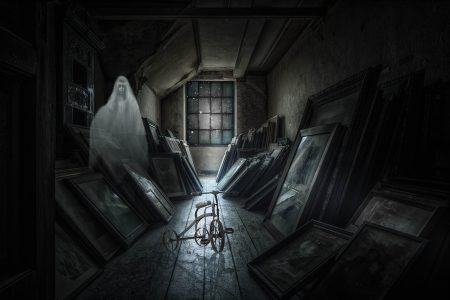
1. Women (40%)
If you need to talk to somebody about ghosts, and you want them to take you seriously, your best bet is to talk to your female friends. According to the results, 40% of American women believe in at least some kinds of ghosts.
That contrasts to men, out of whom only 28% think ghosts might be real. According to experts, the difference could be explained due to differences in attitudes between men and women.
“Women are somewhat more inclined toward phenomena with a social aspect of connecting with other people, such as psychic abilities or astrological readings,” Peter Dendle, a folklorist and English professor at Penn State University, told Newsweek. “There may also be cultural scripts that encourage men to assert themselves with markers of rationality.”
That said, it’s not like men don’t believe in the supernatural — they’re just more likely to believe in more tangible creatures than ghosts. For instance, when it comes to cryptids like Bigfoot or aliens, men are much more likely to believe in them than the ladies.
2. Non-religious People (40%)
Sharing the #1 podium with women are people who don’t attend religious services on any kind of regular basis. The poll revealed that 40% of those who attend a religious gathering — no matter the religion — once a month or less believe in ghosts.
Meanwhile, out of those who attend religious services almost every week or once a week, only 22% of both believed ghosts could exist. However, this result doesn’t necessarily mean people who don’t go to church are more superstitious.
The difference can be explained, at least partially, through differences in belief system. After all, according to most theories, ghosts are dead people who have somehow lingered on in the mortal realm after their deaths.
If people go to religious gatherings on a regular basis, we can probably assume their faith in their given religion is pretty firm. So, if the religion’s theory of the afterlife doesn’t accommodate ghosts, the people probably aren’t going to believe in them — it’d go against their faith.
3. College Non-graduates (38%)
In the third place, we have people who didn’t go to or didn’t finish college. According to the poll results, 38% of college non-graduates believe in ghosts.
Dendle explained that the difference might be due to college classes teaching students to think more critically about the world.
“College graduates may also have a buttress against paranormal beliefs, from greater exposure to courses in critical thinking, science, world history and religion, and cultural analysis,” he said.
Then again, you could take that as college dulling people’s sense on wonder and whimsy and turning them into overtly rational drones. Feel free to make up your own interpretation.
4. Political Moderates (37%)
Perhaps in the most curious twist of the poll, it turns out people who identify as political moderates are more likely to believe in ghosts than those who swear by one partisan camp. The results show that 37% of moderates are ready to believe in ghosts.
Before anyone starts using these results as some kind of harebrained political talking point, let us note that this doesn’t mean moderates are gullible or dumb. It may only indicate that they’re more open to different ideas.
After all, most moderates think there are workable ideas on both sides of the aisle. This openness may then translate into not immediately dismissing concepts like ghosts, either.
5. People Aged 34-54 (36%)
Finally, in the fifth place, we have people aged between 34 and 54. Out of them 36% believe in ghosts.
There’s some stiff competition in this category, though. For example, out of people between 18-34, 34% believe in ghosts, while in the 55+ age bracket, 33% are open to ghosts being real.
Honestly, the differences are so small that they may not mean anything in terms of age affecting belief in ghosts. If anything, the differences in numbers pretty much reflect the U.S. age structure.
Most Common Supernatural Beliefs in America
Despite these results, most Americans do not believe in the supernatural. Out of all people who responded to the Gallup poll, two-thirds said they don’t believe in any of that nonsense.
Out of those that do, however, ghosts were by far the most common article of belief. A whopping 89% of those who do believe in the supernatural believe in ghosts.
Yet, ghosts aren’t the only things people believe in. Here’s the Top 8:
- Ghosts (89%)
- Psychic or spiritual healing (79%)
- Communicating with the dead (66%)
- Telepathy (61%)
- Clairvoyance (59%)
- Astrology (55%)
- Reincarnation (53%)
- Witches (45%)
By the way, you know who’s also in that one-third of Americans who believe in the supernatural? The CIA. You can read more about their experiments spooky stuff here.