
- The world was a much more fantastic place before we figured ghosts might just be owls.
Every story about a mythological creature or monster has to come from somewhere. Unless some trickster completely made the whole thing up, somebody at some point must have seen something.
It may not have been the creature they thought they saw, though. Maybe they were drunk or high, misinterpreted an animal they hadn’t seen before, or simply got spooked by a weird tree in a dark forest.
With some creatures, it’s pretty easy to guess where they came from — the Kraken was probably originally just a giant squid. We can also make a pretty good guess about some other mythical beings.
Here are four creatures of legend, and their most likely origins.
1) The Cyclops

We all know the cyclops of Greek myth, at least the one that Odysseus outsmarted and blinded by shoving a stake in its eye. Ancient Greeks believed the cyclopes were the offspring of the gods Uranus and Gaia.
But there’s a more likely origin story for the cyclops. They were probably some kind of an elephant.
Now, the Ancient Greeks of course wouldn’t have looked at a living elephant and thought it was a one-eyed giant. But take a fossilized skull of a long-dead elephant and you might just see how it turned into the cyclops.

Elephant skulls have a large nasal cavity where their trunk attaches to the skull. Additionally, the skulls of ancient dwarf elephants are fairly common discoveries in Greek caves.
So, it’s perfectly possible somebody found a skull with a huge, eye socket-like hole in its center. Not knowing what creature it belonged to, perhaps the person thought it was the skull of a monocular giant.
2) The Jackalope
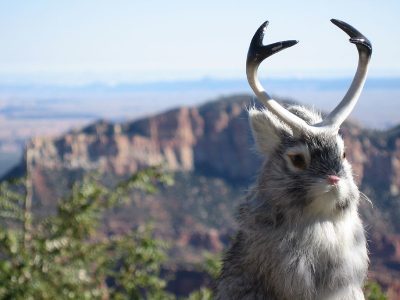
As far as mythical monsters go, the jackalope is probably one of the most harmless. This creature from Midwest U.S. is just a rabbit — but it has horns on its head.
The jackalope was popularized momentarily in the 1930s when taxidermist Douglas Herrick got the bright idea to graft deer antlers onto a rabbit and sell the abomination off as the legendary jackalope. But the story of jackalope is an older one, so it can’t have originated with Herrick.
As far as we know, there are no ancient rabbits that grew horns. But there’s another likely explanation — and it’s a rather sad one.
Rabbits infected with the Shope papilloma virus (SPV) begin growing unusual, keratinous tumors on their heads. These tumors can grow large enough that you could mistake them for horns or antlers.
The disease is no good for the rabbit since the tumors can prevent it from eating, causing death through starvation. But if you look at a picture of an SPV-infected rabbit (it’s really gross, just so you know), it’s easy to see how someone could mistake it for a horned jackalope.

3) El Chupacabra
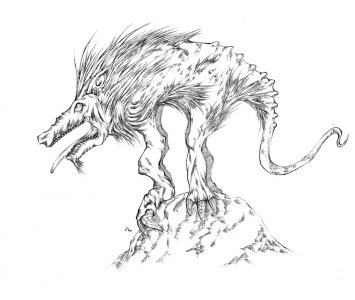
El Chupacabra — or goat-sucker — is a fairly recent addition to the cavalcade of mythical monsters. This beast, which attacks livestock and leaves them drained of blood, was first sighted in Puerto Rico in the ‘70s.
The descriptions of El Chupacabra are often fairly consistent. It’s said to be an emaciated, horrendously ugly, and mostly hairless dog-like monster with bloodshot or red eyes and occasionally bloody and scaly skin.
Know what else looks like that? A coyote or feral dog with advanced scabies.
Scabies is caused by skin mites that infect a wide variety of animals. If the infection gets really bad, the animal — like a coyote — will lose most of its hair and develop skin conditions that cause dry and scaly skin that causes them to itch themselves until they bleed.
In this weakened state, the coyote will have difficulties hunting wild prey. So, the hungry and sick beast might turn to an easier meal… Like a goat or other farm animal.
Additionally, coyotes may seriously injure their prey but not kill it. As a result, the hurt victim is left wandering around until it bleeds out.
4) The Banshee
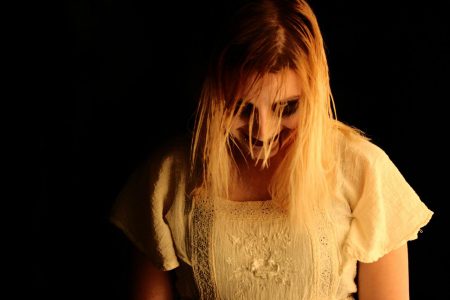
In Irish mythology, seeing a banshee is an all-around unpleasant experience. Not only is this female ghost or spirit scary, but its scream is also one of the most terrible sounds you can hear.
And to top it all off its appearance signifies impending death and doom.
But it’s quite possible that the banshee is based on a much less terrifying creature. Namely, a barn owl.
Imagine you’re an ancient Irish warrior preparing for a fight. Then, the night before the battle, you suddenly see a pale creature looming in the darkness of the forest by your camp.
Without a warning, it emits a high-pitched screech and flies off, screaming all the while. And the next day, most of your comrades die in a bloody battle.
You can bet you’d go home with a story of a horrible wailing ghost whose appearance preceded the deaths of all your friends.