
- Which of these weird cars would you like to try driving?
Have you ever noticed that modern cars all look more or less the same? We’ve pretty much perfected the science behind the automobile, and there are only so many ways to make a fuel-efficient car.
It wasn’t always like that, especially in the early days of motoring. Nobody had yet quite figured out what these car things were and how they were supposed to work, resulting in some wild and wacky machines.
Here are eight examples of strange early automobiles.
1. Cugnot Fardier à Vapeur
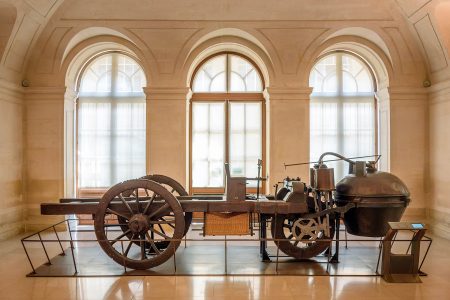
If we’re talking about old, funky automobiles, we have to start with the first one. And no, it’s not the Benz Motorwagen from 1886.
The first self-propelled mechanical land vehicle – that is, an automobile – ever designed was the fardier à vapeur (steam cart) developed by French Army captain Nicolas-Joseph Cugnot in 1769. In practice, however, it was more of a tractor than a car, as Cugnot designed it to haul artillery pieces.
And the thing sucked. It was extremely unstable, slow as molasses, and it needed its steam boiler relit to generate more steam pressure every 15 minutes.
But hey, you have to start somewhere.
2. Gurney Steam Carriage
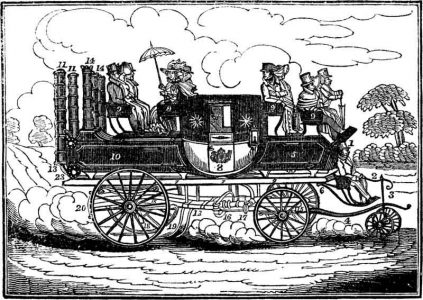
The Gurney steam carriage is another primitive steam-powered vehicle. It’s remarkable for two things: serving as one of the first public transportation cars and the extremely negative reception it received.
In the 1820s, the carriage’s inventor, Goldsworthy Gurney, launched what may be the first bus company. He ferried passengers between London and Bath in England at a blistering 15 miles per hour.
However, the public wasn’t comfortable with this new-fangled horseless carriage. Most people were merely suspicious, but during one of his trips, a group of Luddites attacked Gurney’s machine. They damaged the carriage and wounded its stoker, prompting Gurney to call the police to escort him the rest of the way.
3. Rumpler Tropfenwagen
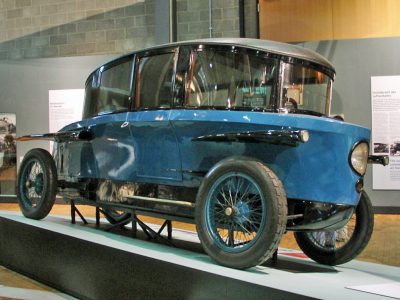
Austrian engineer Edmund Rumpler made his name by designing airplanes for the German Empire during World War I. After the war, he decided to put his aviation knowledge to use in the automotive industry.
The result was the Rumpler Tropfenwagen, the first streamlined automobile. Rumpler used his aviation knowledge to design the strangely long, slim vehicle to have as little aerodynamic drag as possible.
Although the car was aerodynamic, it didn’t really matter as it mostly served as a taxi in slow-moving Berlin traffic. However, some early car racers modified the Tropfwagen into a fast racing machine, allowing Rumpler’s work to shine.
4. Reeves Overland Octoauto
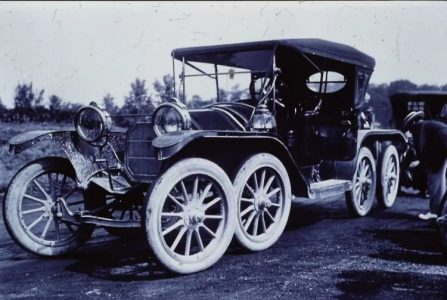
If four wheels give you a comfortable ride, more wheels must mean a more comfortable ride. That was American engineer Milton Reeves’ guiding philosophy when he designed the eight-wheeled Octoauto in 1922.
In a way, he was correct. Early cars had terrible suspension that quickly wore down the wheels. Having eight wheels on four axles did make for a smoother ride.
While Reeve’s Octoauto generated a lot of publicity, it didn’t sell. The reason for the lack of interest was the car’s sky-high $3,200 price – four times as much as a Ford Model T.
People just weren’t ready to pay that much for a bit more comfort.
5. Leyat Hélica
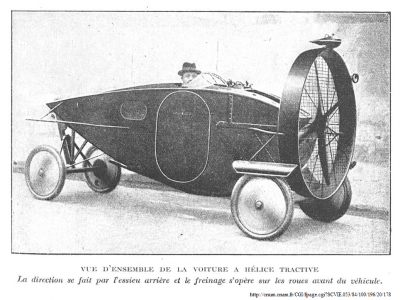
French inventor and engineer Marcel Leyat had a bizarre hangup: he didn’t like transmission systems. With his background in aviation, he was convinced that transmissions were superfluous for automobiles.
His conviction resulted in the Leyat Hélica, an outlandish crossbreed between a car and an airplane. From the automotive world, it inherited four wheels and the ability to move on roads.
From the aviation industry came the humongous propeller that pulled the vehicle forward.
Granted, the Hélica was very fast for its time, reaching a top speed of 106 mph. In fact, it was too fast, and its light plywood construction made it almost impossible to control at high speeds.
Despite it all, Hélica sold 30 of the propeller cars before stopping production.
6. Helicron
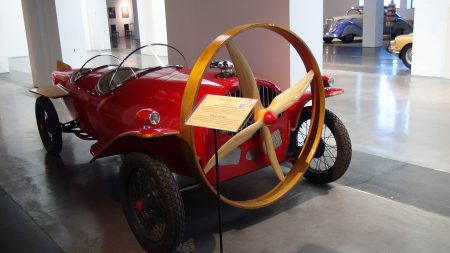
You’d imagine experiments with propeller-driven cars would’ve ended with the Hélica. But here’s the Helicron to show that someone else thought it was a good idea.
But the weirdest thing about the Helicron is that no one knows who built it, where, and why. It was discovered abandoned in a French barn in the 1930s by its mysterious owner.
In 2000, the machine was discovered and repaired. Today, it’s on display in the Lane Motor Museum in Nashville, Tennessee, in case you’d like to go see it.
7. Owen Magnetic
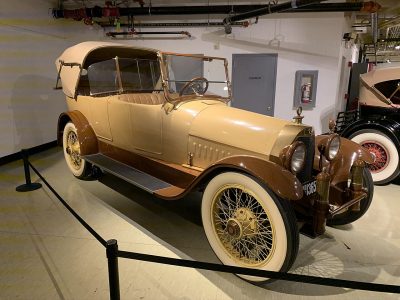
Most cars move by having the engine turn a drivetrain connected to one of the axles. Not the Owen Magnetic, though. It looked like a normal car but was an absolute freak under the hood.
In the 1910s, the Owen company developed a bizarre magnetic drive system. The gas-powered engine was completely decoupled from the axles, and instead of a drivetrain, it spun a large magnet with an electric motor inside it.
The spinning motor would generate an electric current that activated the magnet. In turn, the magnet would pull on the rear axle, making it spin and driving that car forward.
Does that sound needlessly convoluted? It was.
8. Detroit Electric
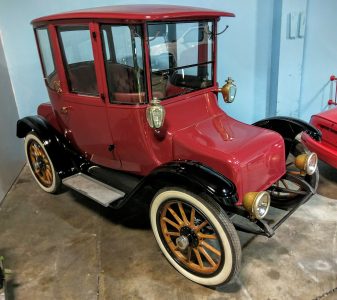
Think electric cars are a modern invention? Think again! They’ve existed since the dawn of automobiles, as the Detroit Electric shows.
This car, introduced in 1907, was powered by a rechargeable lead-acid battery (or a nickel-iron battery if you bought the fancy model). Marketing materials promised a range of 80 miles with one charge, although the car was shown to be able to go more than 200 miles in tests.
On top of that, Detroit Electric was about as fast as any other car in 1907. However, the Anderson Electric Company, the car’s manufacturer, stopped innovating, and by the time production ended in 1939, the Detroit Electric was a prehistoric yet road-legal relic.