
- That’s one pricey pile of s***.
Nobody wants to be around poop. It’s waste, it’s stinky, it’s disgusting.
It can also be very, very expensive.
You won’t earn filthy riches with just any old piece of crap, though. It has to be just the right type of poop, incredibly old, have a specific use, or just be a weird enough turd for someone to pay top dollar for it.
Here are seven examples of ridiculously expensive pieces of poop.
1. Ambergris
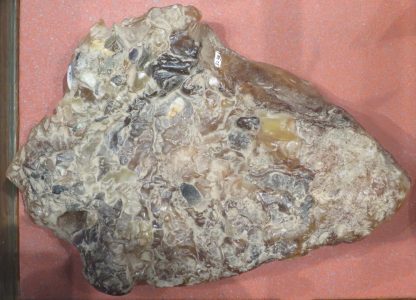
It’s a bit questionable whether ambergris counts as poop. Yet, considering that it’s produced in the digestive tract of sperm whales and it’s stupidly expensive, we’ll say it deserves a place on this list.
Ambergris is a solid side product of sperm whale’s digestion. It’s usually dull gray in color, waxy in texture, and it stinks to high heaven, especially when fresh. The stuff builds up in the whales’ digestive systems until they eject it by pooping or puking.
The gross whale goo is ridiculously expensive, as it’s a sought-after ingredient in some of the priciest perfumes on the planet. It can sell for tens of thousands of dollars per pound — if you can sell it, as the stuff is illegal in many countries, including the U.S.
2. Guano
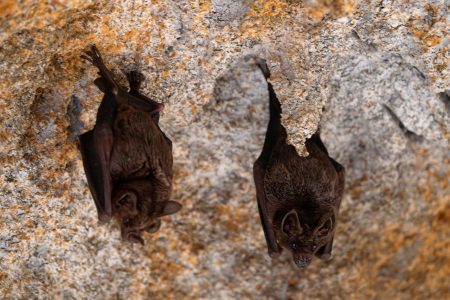
Guano is a word used for the dried-up poop of bats and certain seabirds. It owes its price to the fact that it’s an excellent (although sometimes risky) natural fertilizer.
Guano is still expensive today, with a sack of the stuff possibly costing several hundred dollars, although synthetic fertilizers have somewhat sidelined it. However, in the 19th century, it was one of the best fertilizers around and its price reflected it.
In fact, guano was so lucrative that the U.S. Government passed the Guano Islands Act in 1856. This law allows any American citizen to claim any guano-containing island anywhere in the world in the name of the U.S. — and receive military protection for their claim from the U.S. armed forces.
3. Civet Poop
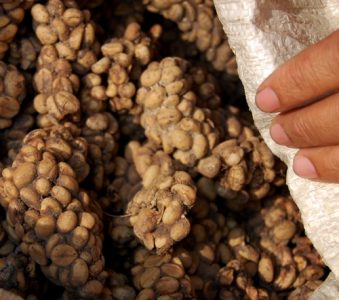
Civets are vaguely cat-like animals living in Africa and Southeast Asia. The poop of the latter is very valuable. Or, well, it’s not really the poop itself but what’s in it.
You see, civets are used to produce kopi luwak, or civet coffee. In the production process, the civets eat coffee cherries. Their seeds, or the coffee beans, pass through their guts undigested but fermented, which supposedly gives them a unique flavor and aroma.
The poopy beans are then collected from the civet droppings and made into coffee. Farmed kopi luwak can sell for hundreds of dollars per bag, while wild-collected crap coffee goes for thousands.
Just a single cup of kopi luwak can cost $100. Too bad it regularly loses to several times less expensive coffees in blind taste tests.
4. Jacu Bird Poop
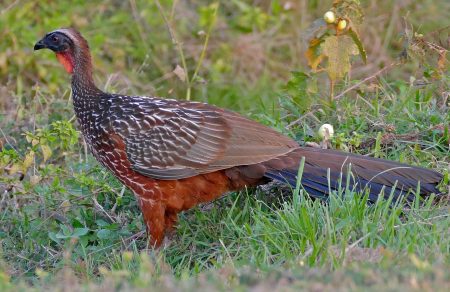
In 2006, Brazilian farmer Henrique Sloper de Araujo noticed local jacu birds eating coffee cherries and defecating their seeds (we’re still talking about coffee beans) undigested. He had a million-dollar idea — he knew people paid filthy amounts of money for civet coffee, so why not bird s*** coffee?
And that’s how we got jacu bird coffee. Looking at the prices online, this stuff sells for more than $100 for a couple of ounces, with bigger bags climbing toward a $1,000 price point.
Apparently, the secret to making a fortune out of coffee is to pick it out of some exotic animal’s feces. What’s next, elephant crap coffee?
5. Black Ivory
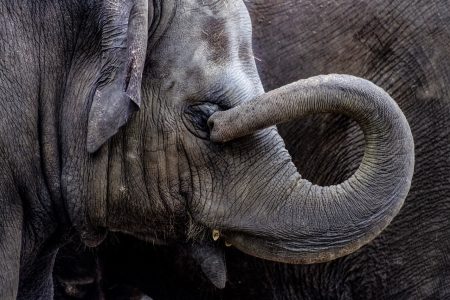
Allow us to introduce you to Black Ivory. It is elephant crap coffee.
It’s made much in the same way as civet and jacu bird coffee, just using a different animal. The elephants eat coffee cherries, defecate, and then the undigested beans are collected from the undoubtedly massive piles of s*** to produce the “world’s rarest coffee.”
For a pound of Black Ivory, you’ll have to shell out $1,500. It might be an unforgettable flavor experience, but pardon us if we decide to stick to perfectly good beans that cost 100 times less (and have never contacted animal feces, hopefully).
6. Lloyds Bank Coprolite
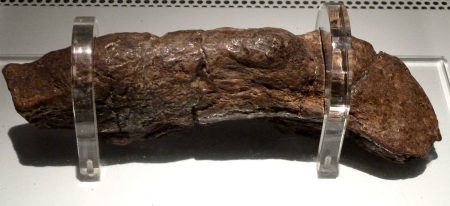
Okay, that’s enough poop-based coffee. Let’s move on to a different, much older dump that was dropped by none other than a human being.
Specifically, a Viking. In 1972, when excavating the site of a future Lloyds Bank branch in York, England, the construction workers happened upon a coprolite — a fancy word for a fossilized piece of crap.
Tests revealed that this was human feces, and it had fallen out of the butt of a Viking who had lived in the 9th-centry settlement of Jorvik. Whoever took this (impressively sized) dump had eaten bread, shellfish, nuts, and fruit, and they also suffered from intestinal parasites.
Due to being unique and extremely well-preserved, the Lloyds Bank Coprolite is estimated to be worth at least $39,000. It’s not for sale, but if you’d like to admire this ancient poop, it’s on public display at the Jorvik Viking Center.
7. Artist’s S***
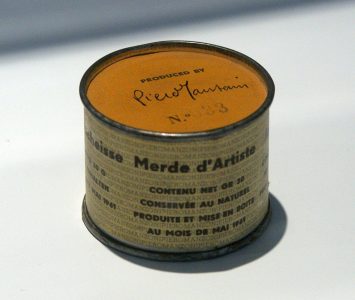
Piero Manzoni was an Italian artist, or perhaps more of an anti-artist. He’s famed for bizarre avant-garde pieces that intentionally challenge the definition of what can be considered art.
One of his most famous… Works is Merda d’Artista. That’s Italian for “Artist’s S***.”
This artwork consists of exactly what it says on the label, because it has a label. In 1961, Manzoni took a big dump and distributed his waste into 90 small tin containers. Each is labeled: “Artist’s s***; contents 30 gr net; freshly preserved; produced and tinned in May 1961.”
When Manzoni “produced” Artist’s S***, each of the 90 cans was worth its weight in gold — in other words, $37 (roughly $400 when adjusted for inflation). Their value has appreciated over the years, though, and whenever a can goes up on auction, it comfortably surpasses the $100,000 mark.