
- And here we thought our commute was bad.
Commuting sucks. You can get stuck in traffic for hours, may have to share cramped and hot public transportation, or — if nothing else — waste endless amounts of money on gas.
Yet, there are some people who would give anything to be crawling down an interstate instead of risking their lives every day. Or, conversely, they’re doing something absolutely bizarre to avoid the traffic jams.
Here are six of the most insane commutes in the world.
1. Daily Private Jet

Curt von Badinski is a mechanical engineer and street artist (what a combo) from California. In 2017, he made headlines because of his crazy commute.
At the time, he was taking a private jet to work every day.
Von Badinski lived in Los Angeles, but the company he worked for was in San Francisco. So, he paid $2,300 a month to take a shared private jet with a few other people to get to the office.
In total, the roundtrip took six hours. It might seem like von Badinski didn’t have time left for work in the day, but he said that the started working on the plane and taking a short break while he drove to his desk.
Try as we might, we couldn’t find out whether von Badinski still rides a private jet twice a day. However, we can’t help but wonder if it wouldn’t have been easier to just move to San Fran.
2. Kayaking to the Office

George Bullard lives in Wales. Since 2015, he has been kayaking to his office when the weather allows.
It’s sort of fitting, as Bullard runs a camping company. In the morning, he dons his suit, hops in the kayak, and paddles to work up the River Lugg.
Bullard takes the kayak partially because he’s sick of driving to work. With the kayak, he saves money and his nerves by avoiding spending gas and getting stuck in crawling traffic.
That said, he advises against imitating his commute unless you’re a seasoned kayaker. For his part, Bullard certainly has the necessary experience, considering he’s kayaked from Greenland to Scotland.
3. Wicker Toboggan Rides

The town of Monte is located on the Portuguese island of Madeira. A part of the town is situated on a large hill, while the rest of it sits at the foot of said geological feature.
In the 19th century, the locals came up with an innovative way to make at least the downhill trek faster and a lot more exciting. They began sledding down the streets in what are essentially wicker toboggans.
This commute even gave rise to a unique profession. Carreiros are men who push and steer the toboggans, dressed in a traditional white uniform and straw hat.
These days, cars have replaced the toboggans. Yet, you can still get an old-fashioned ride down the hill by booking a slide with one of the many tourism companies that still hire carreiros.
4. Swimming Across a River

Abdul Malik is a teacher from Kerala, India. Since 1994, he has commuted to work by swimming across the Kadalundi River.
In the morning, Malik packs his clothes and belongings in a waterproof bag, straps it to his bag, and jumps in the river, swimming 15-30 minutes to reach his school. He repeats the journey back (fortunately downstream) in the evening, even during the dangerous monsoon season.
He does it because he’d rather brave whatever the river has in store for him than take the three-hour bus ride to get to his school by road. “It is better to swim than depend on unreliable transport,” Malik mused.
Not only does he set an example in perseverance (and spite for poorly organized traffic), but Malik also promotes environmental awareness during his daily swims. While in the river, he scoops up plastic trash floating by and disposes of it appropriately.
5. Zip Wire Over a Gorge
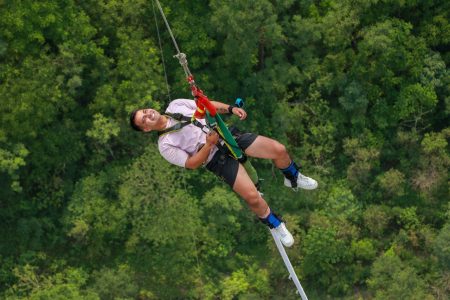
Guayabetal is a small village in the mountains of Columbia. It has a neighboring larger town that’s not very far away.
The problem is that they’re separated by a 1,200-foot-deep gorge.
For decades, locals have solved their commuting problem in a creative and daring way. They’ve been building zip wires across the gorge, sliding across the yawning chasm at 60 miles per hour.
Originally, the wires were made of hemp rope, but they’ve since been replaced with steel wires. Still, more than 20 people have reportedly perished by plunging into the depth due a snapped rope.
Due to the inherent danger, the local government has officially banned the zip wires, taking them down whenever they find them. Yet, the people of Guayabetal keep putting up new ones — because they’re just faster than taking the long, snaking mountain roads.
6. Climbing a 200-foot Cliff

Did your grandparents tell you how they had to walk to school uphill, both ways? Well, not to insult your gramps and gramma, but they got nothing on these Chinese kids.
In 2013, news broke of the death-defying school trip the children of Zhang Jiawan, a small village in the Hunan province, take twice a day. You see, Zhang Jiawan is surrounded by 230-foot-high cliffs.
In the past, the location was ideal as it made the village practically impervious to Mongols and other invaders. In the modern day, there’s one issue.
The only school in the area is at the top of the cliff — and there’s no road.
So, the people of Zhang Jiawan erected long wooden ladders that scale the cliff. They’re not bolted to the cliff of anything, being held up only by physics and what we assume is a not insignificant amount of prayer.
As to the kids who have to climb the rickety things, the adults have three words of advice: “Don’t look down.”
It’s not like the locals want to force their kids to risk their lives for education. They’ve been lobbying for a road, but — according to news at the time — the local government states it’d be cheaper to fly the kids up the cliff in a helicopter twice a day.
Which brings up the question of why they’re not doing that, then. Unfortunately, we couldn’t find out whether the village has received a road in the intervening years or if the kids are still climbing the cliff today.