
- Ground Control to Manhole Cover, how did you get up there?
Space launches are both incredibly expensive and potentially dangerous, so you’d imagine they’d be humorless, no-nonsense scientific affairs. And they are, for the most part, but the rockets may still carry something utterly unhinged.
Ever since Sputnik in 1957, all manners of strange things have made it into Earth’s orbit and beyond. Some of them went up on purpose, others were smuggled by astronauts — and some things traveled to space by complete accident.
Here are eight of the strangest things that have been launched into space for one reason or another.
8. Buzz Lightyear
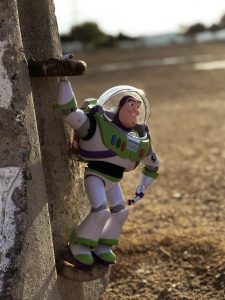
In 2008, Buzz Lightyear traveled to infinity and beyond. Or, well, at least to the low Earth orbit.
As part of an educational outreach program associated with Space Shuttle Discovery’s STS-124 mission, NASA launched a Buzz Lightyear toy to the International Space Station (ISS). The action figure stayed on the station for 468 days before returning to Earth.
Once it landed, it got the same triumphant welcome as astronauts (probably because it came down with a bunch of real astronauts). Today, the toy is part of the Smithsonian’s National Collection.
7. Golf Balls

Astronaut Alan Shepard liked golf. So, when he was chosen to participate in the Apollo 14 mission to the moon in 1971, he was determined to golf where no man had golfed before.
Shepard smuggled two golf balls with him onto the spacecraft. Using a custom six-iron attached to a material sampling tool, he teed off the balls on the lunar surface.
The first one landed sadly in a nearby crater, but Shepard claimed the second one flew for “miles and miles.” Unfortunately for him, photographs taken as part of the moon mission proved that the ball only flew about 120 feet.
6. Hip-hop

Music records have been launched into space several times. In July 2024, however, NASA decided to do better.
Using the Deep Space Network telecommunications system, the space agency transmitted Missy Elliot’s song “The Rain (Supa Dupa Fly)” to Venus. They didn’t just send a record up there — they played the song on intergalactic radio.
You know what, this is a much more sensible approach to give possible aliens a sample of Earth music. After all, the little green men may not have vinyl or CD players.
5. Jellyfish
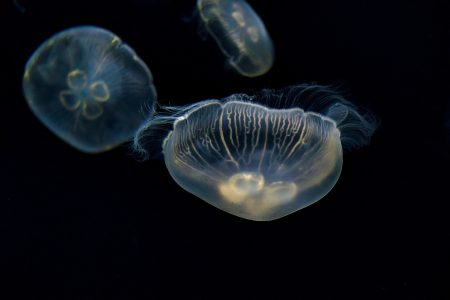
In 1991, the space shuttle Columbia took 2,000 jellyfish polyps (that is, baby jellyfish) up to space, alongside a supply of seawater for them to live in. The purpose of the experiment was to see whether the polyps could grow up in zero gravity.
To everyone’s surprise, they didn’t just grow up — they had a baby boom. When the shuttle returned to Earth nine days later, it carried more than 60,000 jellyfish.
Yet, having grown up in space, the jellyfish couldn’t adapt to gravity. They couldn’t comprehend the concepts of “up” and “down,” and never learned to swim properly on Earth.
According to scientists, something similar would probably happen to people who were brought up in zero gravity.
4. Pizza

In 2001, Pizza Hut decided to blow $1 million in a completely outlandish marketing campaign. We mean that literally — they delivered a pizza to the ISS.
This was a special pizza, though. Being in space actually dulls your sense of taste, so the pizza was prepared with extra spices and salami instead of pepperoni.
However, despite Pizza Hut being an all-American company, the NASA astronauts on the ISS weren’t allowed to eat the pie due to the agency’s rules about corporate sponsorship. The Russians, however, had no such qualms, and they happily welcomed the change to the regular space station grub.
3. Tesla Roadster
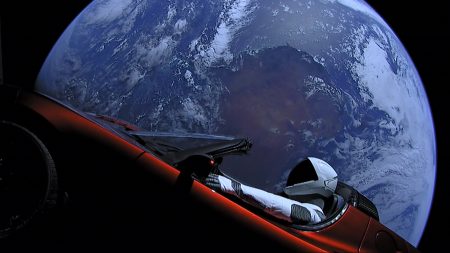
Speaking of marketing campaigns and space, it’ll be kind of hard to beat SpaceX’s stunt from 2018. To demonstrate the power of its then-new heavy rockets, it launched a Tesla Roadster into space.
You know, since both companies are owned by Elon Musk.
“Driving” the Tesla was a mannequin dressed in a space suit called Starman. And he sure took the car for a spin, as he’s currently orbiting the sun.
According to current calculations, the Tesla and Starman will eventually crash into Venus. That won’t happen for a few million years, though, so he has plenty of time to enjoy his joyride — and listen to David Bowie’s “Life on Mars” which blares on repeat through his stereo system.
2. Presidential Hair

Celestis, a Texas-based company performing space burials, launched unusual remnants into space in January 2024. Specifically, they put samples of four previous U.S. presidents on the rocket.
George Washington, John F. Kennedy, Dwight D. Eisenhow, and Ronald Reagan all had their hair leave Earth on the Enterprise mission. The launch was named so as the rocket also carried a part of the ashes of Star Trek creator Gene Roddenberry (whose remains had already been launched into space in 1997).
Eventually, the hair and ashes are destined to leave the solar system and head into the great unknown of deep space. We can only imagine how confused some aliens must be if they find and open the Enterprise rocket.
1. Manhole Covers
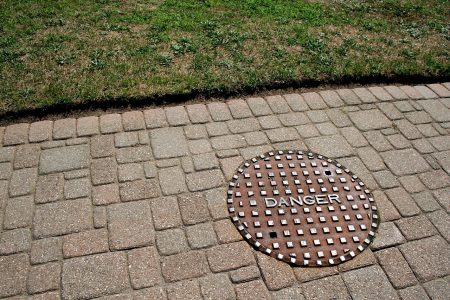
In 1957, the U.S. military carried out the underground Pascal-A nuclear weapons test. Following the experiment, the test facility crew noticed one maintenance hole cover had mysteriously disappeared.
Did it fly off or did the nuclear blast vaporize it? Well, the only way to find out was to do it again.
So, for the follow-up Pascal-B test, they installed a brand-new hole cover. It, too, vanished, but this time, the test crew had set up a camera to monitor the hole.
According to the video footage, the nuclear detonation sent the manhole cover flying at a speed of 125,000 miles per hour. For reference, that’s more than five times the speed needed to break free of Earth’s gravity.
Considering that neither manhole cover has ever been recovered, Robert Brownlee, the lead scientist of the Pascal tests, believes both of them are currently barreling through space. Not only that but they’re also possible candidates for the fastest man-made objects ever made.
All by a complete nuclear accident.