
- Put down your parrot, but you can keep your eyepatch — that was a real thing.
Yarr, avast, and so forth! It’s National Talk Like a Pirate Day, so grab your parrot, tricorne hat, and comically oversized earrings, and make some landlubbers walk the plank.
Well, that’s how we picture pirates in the popular imagination, anyway. But the weird thing about pirates is that a lot, if not most of what we think they were like comes from novels and movies.
That just goes to show what masterful writers Robert Louis Stevenson, Daniel Defoe, and others were. But it also begs the question of what real pirates were like.
In honor of this most swashbuckling of days, let’s take a look at some strangely common misconceptions about pirates, where they came from, and what the (probable) truth was like.
1. Pirates Kept Parrots as Pets

Let’s knock the easiest-to-debunk misconception out first. No, pirates didn’t keep parrots as pets.
At least, not to such an extent that it would be any kind of a defining characteristic. There are no historical records of any known pirate who kept a pet parrot.
That’s not to say that they couldn’t have done so — birds were strangely popular pets in the 17th and 18th centuries, after all. We’re just saying, it’s not a pirate-specific thing.
2. Pirates Made People Walk the Plank
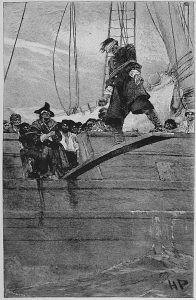
Pirates forcing a prisoner to walk the plank is pure fiction. The whole concept originates from writings attributed to Daniel Defoe and there are no records of it ever actually happening.
Besides, real pirates practiced a much crueler method of torment — keelhauling. They would tie the victim to a long rope, toss them overboard, and then drag them underwater to the other side of the ship.
The victim would usually die in three ways. If they were fortunate, they’d pass quickly by breaking their neck when the tightening rope smashed them against the bottom of the ship.
In the next best-case scenario, they’d drown. But if they were really unlucky, they’d survive the dive with horrendous (and likely infected) wounds as the razor-sharp barnacles on the underside of the ship shredded their flesh.
3. Pirates Mutinied All the Time

If you’re reading or watching a story about pirates, you know there will be a mutiny. In reality, though, mutinies were very rare.
Part of the reason was that there was discipline even on a pirate ship. Most crewmembers had previously served in various navies and knew that a ship wouldn’t survive unless everybody did their jobs.
Additionally, pirates didn’t need to mutiny — they could just vote an unpopular captain out of power. Most pirate ships ran as pseudo-democracies where the crew could elect their captain.
Well, they could sometimes do so before the captain refused to relinquish his position. Now that’s when you mutiny.
4. Pirates Wore Earrings for Fashion

In popular culture, pirates are often depicted as wearing big golden earrings. And that’s actually pretty accurate since they did wear earrings.
They didn’t do it to look fabulous, though. The gold earrings ensured the pirate could get a decent funeral.
If a pirate died, his crewmates could sell the earrings to pay for a casket and funeral arrangements. And that’s not even the only kind of insurance pirates practiced.
5. Pirates Were Backstabbing Outlaws

There’s no honor among thieves, and there certainly were plenty of murderous, immoral pirates. But in general, pirates looked after each other because who else would?
They even had insurance policies. Should a pirate lose a limb or otherwise become incapable of serving on the ship during battle or in an accident, they’d receive a payment collected from the rest of the crew to help them start a new life.
And there are the pirates who were outstanding, respected citizens or even important politicians. Not every pirate was an outlaw — some were sanctioned by the governments of the time to ransack other countries’ ships and earned plenty of glory doing so.
At least in their own country.
6. Pirates Buried Treasure All Over the Place

Should pirates seize a chest full of gold and jewels, they certainly didn’t bury it. After all, there’s no point in having all that cash if you can’t spend it.
That said, there is one known instance of a pirate burying some booty. On the way to his trial, Captain William Kidd hid some of his wealth on Gardiners Island off the New York coast in 1699 to try and… You know, be less of a pirate.
However, the treasure was found and used as proof against him during the case. That should certainly teach other pirates that burying treasure is a bad idea.
7. Pirates Stole Treasure in the First Place

There’s one more reason why pirates didn’t bury treasure, and that’s because they rarely stole any. Think about it —what good is money for you when you’ll be killed on sight in most ports?
Pirates simply had scant few opportunities to spend any precious booty. So, what did they steal?
Anything that they might need to keep their ship afloat. Instead of gold and silver, pirates tended to favor weapons, food, tools, sail canvas, and lumber.
Not that they’d ignore a treasure chest if they found one. We’re just saying, gold won’t feed a hungry pirate or plug a hole in the ship.
8. Pirates Flew Just the Jolly Roger

The crew of the merchant ship spots the black, skull-adorned flag on the pirate ship and flies into a panic. We’ve all seen this scene, but the Jolly Roger wasn’t the worst flag you could see on a pirate ship.
Sure, it meant that you were about to get into a fight. But it also signified that even if you lost, you might get to live, even as a captive.
What you really should fear was a red flag. That was the sign of “no quarter” — the pirates intended to mercilessly slaughter every living person on the targeted ship, even if they surrendered.
9. Pirates Are Restricted to the Caribbean
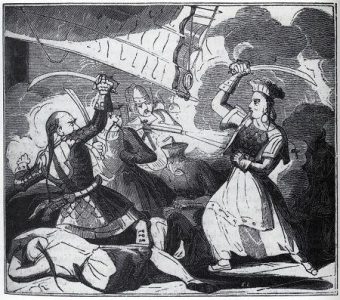
When we think of pirates, we think of scallywags sailing in the Caribbean in the 17th and 18th centuries. However, this period — known as the Golden Age of Piracy — lasted only for a few decades.
Pirates, however, have existed all around the world probably as long as we’ve known how to sail the seas. For instance, Julius Ceasar (yes, the Roman emperor) was once captured by pirates from what is now Turkey.
And then there’s Chinese pirate queen Ching Shih, arguably the most successful pirate in human history. At the height of her power in 1805, she ruled over a pirate confederation of 400 ships and up to 60,000 men, with 24 ships and 1,400 crew under her direct command.
In 1810, she negotiated her surrender to the Imperial Chinese government. Ching Shih retired from piracy and lived the rest of her life in luxury.