
- Did he want to save the English language or just dictate how people should speak?
As you get older, you might find yourself getting irritated by the way the young’uns speak. That’s normal and most people simply grumble about it to themselves.
Not William Barnes, though.
This 19th-century poet and linguist from England hated that the English language was borrowing words from other languages. He set out on a campaign to reform English and return it to an anglicized form that would use only words of Anglo-Saxon origin.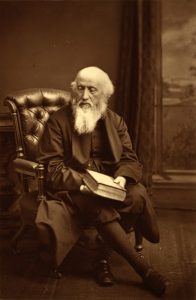
That campaign didn’t really take off. However, it gave us Barnes’ essay in which he suggests alternative “pure” English words to use instead of more common ones derived from Latin.
Some of them make sense, like saying “wicked” instead of “depraved.” Others… Well, they’re not such great translations.
Here are 11 of our favorite examples of Barnes’ funny and/or weird attempts (and their more comprehensible meaning) to make English more English.
Bendsome (Flexible)
The word “flexible” stems from the Latin “flectare” and “flexibilis,” which means it was utterly unacceptable to Barnes. His replacement word was “bendsome.”
It’s one of his more sensible if a bit silly suggestions. Barnes himself could’ve stood to be more bendsome with his attitude.
Forestonening (Fossil)
If you read Barnes’ essay, you have to understand that he was writing for an academic audience. As such, some of the words he chose to anglicize are a bit niche — like “fossil.”
Barnes’ replacement word for “fossil” was “forestonening.” It’s a noun based on his anglicization of “to petrify,” which he turned into “to forestone.”
Fornaysome (Negative)
Now we’re getting into the words where Barnes is really reaching for an all-English alternative. “Fornaysome” is a weird construction based on “nay” and the “fore-“ and “-some” components we’ve seen before.
It’s just really awkward. In this case, it really just seems easier to use the foreign loan.
Hairbane (Depilatory)
We all use the word “depilatory” on a daily basis, right? What, you don’t? Well, just for clarity, something is depilatory when it removes unwanted body hair — like your razor.
Barnes’ alternative word is the hilariously dramatic “hairbane.” It sure gets the meaning across, but how many times is “depilatory” ever going to come up in your life?
We’re just saying, maybe Barnes was kind of tilting at windmills here.
Henchman (Satellite)
Barnes wrote his linguistic essay when man-made satellites weren’t a thing. At most, a “satellite” was something like the moon, i.e. an orbiting celestial body.
In this sense, “henchman” is actually a decent substitute, even if its modern meaning is a bit different. It would be kind of cool if we had NASA launch a new henchman into the Earth orbit.
Matter-quickness (Electricity)
We can’t quite make out what exactly Barnes means by “matter-quickness.” He offers it as an alternative to “electricity” but then he goes on to say that it describes “not speed, but liveliness.”
“The word electricity means, as a word, only amberishness,” he writes. Anyone know what “amberishness” means?
Speech-craft (Grammar)
Barnes was mildly obsessed with linguistics, so it’d make sense that he would offer alternatives for linguistic terms as well. One of those was “speech-craft,” his alternative for “grammar.”
Honestly, we really like this. It sounds a lot more impressive, you know. “Why yes, I studied speech-craft in college.”
Talksomeness (Garrulity)
Out of all the words Barnes lists that nobody would ever use, this has to take the cake. “Garrulity” is an obscure word for someone who talks a lot.
So, Barnes offers “talksomeness” as an alternative word. Wonder if he’s ever heard of the word “talkative” before.
Thought-pilfering (Plagiarism)
Some of Barnes’ anglicizations are hilariously literal — like this one. After all, what is “plagiarism” if not “thought-pilfering.”
We should start using “thought-pilfering” in our daily speech. Come on, people, let’s all thought-pilfer this one from Barnes.
Unfullening (Depletion)
The word “depletion” comes from the Latin word “deplere,” which means “to empty.” As such, it makes sense that Barnes would want to replace it.
That said, he didn’t need to come up with something as awkward as “unfullening.” That’s because we already have the word “emptying” which comes from the Old English word “?metta.”
It kind of seems that maybe Barnes just wanted people to use his words instead of anything else.
Weeking (Pirate)
The word “pirate” is of Greek origin and as such it has to go. Barnes offers a replacement word with several spellings, including “weeking,” “wyking,” and “wicing.”
All of which mean “Viking.” That spelling was already common in Barnes’ time, so why did he need to dig up these ancient variants?
You know, it’s official. Barnes didn’t want English to be “pure” — he just wanted everyone to talk and write the way he told them to.