
- Get ready for a 10,000-year-old story of survival, death, and… Snake incest?
Ilha de Queimada Grande is a small Atlantic island off the coast of Brazil. It has a temperate climate, yet its varied terrain ranges from the craggy coast to dense rainforest.
Sounds like a nice vacation spot, right? It’s too bad you can’t ever go to the island.
Not that you’d really want to. You see, Ilha de Queimada Grande is full of snakes.
Very, very dangerous snakes.
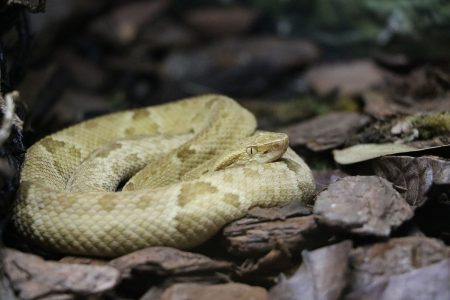
This is the only place where you can find the golden lancehead, one of the world’s most venomous pit viper species. The abundance of the vipers has given Ilha de Queimada Grande its common nickname — Snake Island.
They’re also why the Brazilian Navy blocks anyone but certified snake researchers from going to the island. Unless you’re a snake expert who knows exactly what they’re doing, you’ll likely be dead soon after landing.
Yet, there may not be as many snakes on Snake Island as people have previously thought. In fact, the golden lancehead might actually be in kind of dire straits.
So, what’s going on with Snake Island? And how did the snakes get there? This is the strange but fascinating story of one of the world’s deadliest places.
The Rise of Snake Island
Today, Snake Island covers roughly 106 acres of land sticking out of the Atlantic Ocean some 21 miles off Brazil’s southeastern coast. Its shores are rocky, but in the central hills, you’ll find the aforementioned rainforest areas.
However, Snake Island wasn’t always an island. Let’s turn the clock back 10,000 years to shortly before the end of the last ice age.
And what’s this? There’s a strip of land connecting Snake Island to the Brazilian mainland!
This land bridge is what the golden lanceheads’ ancestors used to slither their way to Snake Peninsula. Once the ice age ended and the huge glacial masses melted, the resulting rising ocean levels covered the low-lying land bridge, turning Snake Peninsula into the Snake Island we know.
To Kill a Bird
Alright, so now you know how the snakes got onto the island. But the next mystery awaiting us is the golden lancehead’s venom.
The venom of these snakes is incredibly potent, being five times stronger than that of their closest relatives living on the mainland. It’s also the fastest-acting poison out of all pit vipers, purpose-made to result in a swift death.
But if Snake Island’s serpents came from mainland Brazil, why are they so much more venomous than their relatives?
The answer lies in what the snakes eat. There are no mammals at all on Snake Island, so the vipers have to rely on catching birds for their dinner.
However, they’re ridiculously picky eaters. Although there are 41 species of birds on Snake Island, the snakes rely almost entirely on two of them—the southern house wren and the Chilean elaenia.
Both of these birds are small, quick, and cautious. Those vipers with slower-acting venom found that their meal flew away to die elsewhere, while those with quicker-killing venom were able to chow down.
Let evolution do its thing, and the vipers’ venom got faster and faster at ending the victim’s life over thousands of years.
Since no people are allowed on the island, and those that go there always carry appropriate anti-venom, we don’t precisely know how fast a golden lancehead would kill a person. Yet, considering that less venomous pit vipers’ bites quickly cause nausea, intestinal bleeding, and brain hemorrhage, it could also be that no one who got bitten on Snake Island made it out to tell the tale.
The Worst Job in the World
Speaking of people dying of snake bites, that brings us to Snake Island’s naval blockade. As we mentioned, nobody but specific researchers is allowed to go to the island.
It wasn’t always like that way. In fact, in the early 1900s, there was even a lighthouse on Snake Island (for the express purpose of steering ships away from it).
That meant that somebody had to stay there to keep the lighthouse operational. We can only imagine that Snake Island’s lighthouse keepers were told not to leave their cabins unless it was absolutely necessary.
Yet, they must have gone out and kicked the bucket, because in the 1920s, Brazil’s Navy declared it off-limits to virtually everyone. Perhaps they got tired of picking up dead lighthouse keepers.
That actually brings us to the legend of Snake Island’s last lighthouse keeper. Officially, the island’s last inhabitants were evacuated shortly after the quarantine when the lighthouse was fully automated with modern technology.
Yet, local stories claim that the last lighthouse keeper and his family died after snakes slithered their way into their house through open windows.
The Next Chapter
And there we have it — Snake Island is a dangerous that’s isolated from the rest of the world for a good reason. Yet, the quarantine is there to protect the snakes as much as it is to protect the visitors.
After all, the golden lancehead only lives on this small island. And there actually aren’t as many snakes as people used to think.
Earlier, researchers estimated that there were as many as 430,000 lanceheads on Snake Island, or one per every 10 square feet. However, relatively recently someone realized that such a ridiculous number of snakes simply wasn’t sustainable on the small island.
Indeed, more accurate estimates have drastically lowered the estimated number of snakes. Now, it’s believed up to 4,000 snakes live in the island’s rainforests.
That sounds more realistic. Although the snakes are doing fine for themselves, there are few enough of them that they’re listed as critically endangered.
And they are kind of endangered, but not because of any outside threat. Instead, the risk is…
Well, with (relatively) few snakes around, it can be hard to find a mate. So, researchers are worried that the snakes might be starting to be unhealthily interested in their own relatives.
It seems Snake Island’s weird story is getting into a new chapter — one that’s about serpentine incest.