
- If you remember these trends, well… You’re old.
The 1950s is often considered a kind of a golden age for America. Sure, there was still work left to do vis-à-vis civil rights and stuff, but overall, the country was booming.
With Americans able to get back to normal life after the horrors of WWII, many pop culture and social phenomena that persist to this day got their start in the 1950s, from rock ’n’ roll to TV dinners. But not everything from the ‘50s has withstood the test of time.
Here are 7 fun, strange, and bizarre things and fads from the ‘50s that never made it out of the decade.
1. Encasing Everything in Jell-O

It’s not like Jell-O has disappeared — it’s still reasonably popular with both kids and adults (think Jell-O shots). But in the 1950s, people went completely nuts about it.
They didn’t just eat Jell-O. They encased foods in gelatin that had no business being in it.
Anything from fruit to vegetables and even lamb chops somehow found their way into a jiggly casing. Yet, there was a more or less reasonable explanation for it.
Refrigerators had started becoming more accessible in the ‘50s, but they were still fairly pricey. And since you need refrigeration for gelatin to set, serving bizarre stuff in Jell-O was a way to show off that you could afford a fridge.
2. Wearing Dog Collars on Your Ankles
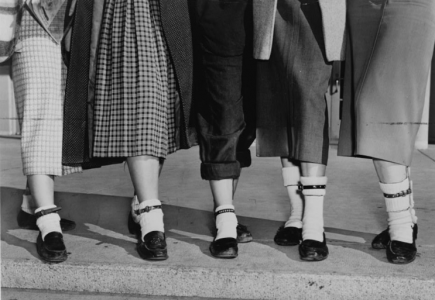
We bet that no matter what decade you go in history, there’s some odd youth trend going on. In the 1950s, among young ladies that trend was wearing dog collars on your bobby socks (which were another fad).
Don’t ask us to explain how this trend got started. But we do know that the collars were a way for teenage girls to display their social status.
Which side you wore the collar on could indicate whether you’re daring or single, and the color could signify various things as well. There were a lot of regional rules, though, so it’s impossible to make any kind of sweeping generalizations about the fad.
3. Telephone Booth Stuffing

While teenage girls were strapping dog collars on their legs, the boys were engaging in something different altogether. They were cramming themselves into telephone booths.
Perhaps we should explain. A telephone booth is a structure that houses a public telephone that you could use in exchange for money, since people didn’t have cell phones yet (or necessarily even telephones in their homes).
Toward the end of the decade, young boys and men decided it would be fun to try and fit as many people as possible inside telephone booths. Reportedly, the fad started as a one-off stunt by South African college kids before blowing up and making it all the way to America.
Boys will be boys, we suppose.
4. Bullet Bras
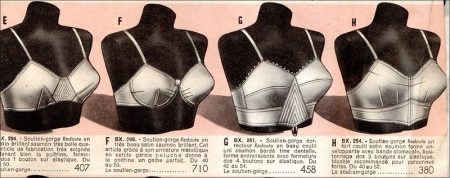
Now, they weren’t called “bullet bras” at the time. In the 1950s, these unnaturally pointy pieces of lingerie were known as circle stitch, whirlpool, or uplift bras.
But why did women decide they wanted their bosoms to resemble sharp-ended cones? Well, it wasn’t entirely intentional.
The shape was simply initially a result of how the cups of a brassiere were manufactured to provide as much support as possible for bustier ladies. Consequently, their chests ended up being a bit pointier than with modern bras, but not particularly extreme.
The most ridiculous examples of these sharp bras were purpose-made for slimmer women. They were simply another fashion fad that died soon after being born.
5. Every Kid Wanted a Hula Hoop

Hula hoops (although not always known as such) have existed for centuries. But in 1957, Australian toymaker Alex Tolmer struck gold by developing the modern plastic hula hoop.
The thing was perfect for swinging it around your hips. It was light, flexible, reasonably durable, and — above all — it was much cheaper than the previous bamboo hoops.
These plastic hula hoops made their way to the U.S. in 1958 and they exploded in popularity. Within four months of their introduction, stores reported selling a total of 25 million hula hoops.
The hoops cost around $20 in today’s money. However, they kept the ‘50s kids busy for hours on end, so we’re sure parents were happy to cough up the dough.
6. Questionable Uses for Radioactivity
Nuclear power made its explosive entrance in WWII. After the war, however, all things nuclear were seen as the way of the future.
On one hand, it did give nuclear power plants and all other actually useful uses for radioactivity. On the other, people did some very iffy things while still trying to figure out what uranium actually is good for.
As one fairly horrifying example, there were uranium-laced sand baths for your hands and feet. We probably don’t have to tell you why burying your limbs in radioactive sand is a bad idea.
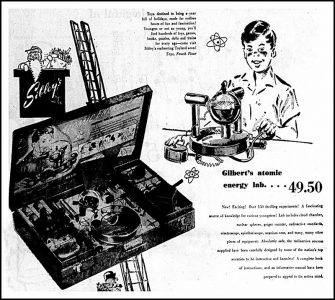
Kids got their dose as well. For instance, the A.C. Gilbert Co. released the Atomic Energy Lab toy set in 1950, containing both uranium and alpha, beta, and gamma radiation sources for children to experiment with.
7. Making Baby After Baby After Baby
You might find it weird to call having children a trend. But that’s absolutely what it was, at least looking at the statistics.
Post-WWII, the U.S. birth rate exploded. Throughout the ‘50s, it stayed well above 23 births per 1,000 people until starting a rapid fall from 1960 onward.
It makes sense, though. After going through hell, wouldn’t you just want to just settle down and have a happy family?
And that, children, is how we got the Boomers.