
- This has more of the board game history you're looking for.
In 1883, board games were more popular, with conveniences of households and eight hour days. People simply had more time. Also, prices came down and people could afford to buy more.
The games tried to reform people or deal with the moral decline by injecting moral truths back into American life through the games.
Parker was interested in fun and play and making people laugh for his games, rather than educating them for moral betterment. Parker always had ideas, but his dad died at a young age. Parker and his brothers needed to be successful and bring income into the house.
Parker creates the first of his board games: Banking and pitches it to two Boston publishers, who both reject him.
He spends his life savings to print 500 copies and asks his teacher for permission to take off the month of December to distribute his games. He makes a profit of about $80, or $2,000.00 today, which pushes him to continue.
His company began to grow and he realized he had a problem. He didn’t like the business side of business, so he brought in his brother Charles and they called it Parker Brothers.
Bradley has games and puzzles and is the first in the US to produce croquet sets. Games geared towards children combining education with fun were becoming more popular as well.
Investors aren’t happy about the change and say that they should not market to children. Tapley argued that children are good business. With Tapley’s backing, Bradley becomes the leading game maker in the United States.
All the while, Parker wants to take over the gaming industry. He was so young and looked even younger, so it was suggested he grow a beard and a mustache. He also took to dressing well in fine suits.
Parker pushes to evolve his games with Crossing the ocean, a role playing game. Parker pursues better ideas and even sailed to England in the 1890s. There he found Tiddlywinks and Ping Pong and eventually beat Bradley in all those areas.
In 1893, Parker’s Brothers annual sales hit $3 million in today’s money and the success gets the attention of his rival. Bradley thinks Parker’s games are showy and gaudy and Bradley didn’t want to have to “chase a kid” in the business.
A third toy maker was about to turn their world upside down.
In 1900, 7/10 workers made less than $0.20 an hour and most workers were working 6 days a week. There was a huge gap between the poor and wealthy.
Elizabeth Magie wrote stories, poetry and was an actress. She also created The Landlord’s Game, which taught against the evils of monopolies and showed that landlords shouldn’t be allowed to bankrupt their tenants.
There was no starting or ending point to this game, so you could continuously keep playing. This game is different from anything anyone has seen before and safe to safe different from all board games to come.
To have more of an impact, she needed a bigger distributor and she wants it to be Parker’s Brothers. But it had morals and values and Parker tells her no, it has no chance of success.
1920s were good to the game industry and there’s a boom in consumer spending. But by the end of the decade, the stock market crashed. There was economic suffering on an unprecedented scale in American history.
In 1932, the Darrow family struggled while he did odd jobs to try and make ends meet. He works on a board game idea to pass the time.
He thinks up a board game for buying and selling property. Monopoly.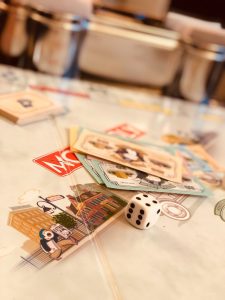
The first Monopoly game was in the shape of a circle (because his kitchen table was a circle.) Darrow sends his game to Bradley and he says no.
He went to Parker Brothers next. “We don’t think it fits our line right now”
Darrow was rejected by both of the big players and he printed copies of his game, a huge risk during the depression. He convinces Wanamakers to sell his game and Monopoly went on the shelf.
Darrow travels to NY City to FAO Schwarz who also agrees to sell the game. Then he waits. And in both stores, Monopoly sells out.
The Parker team were on it to get Darrow in and jump on Monopoly before someone else got him. Darrow sells the rights for $7,000 or $135,000.00. However, Darrow gets a percentage on every game sold which makes him a very rich man.
For the last of the story, follow the link to read History of The Big Players In Board Games: Part Three.